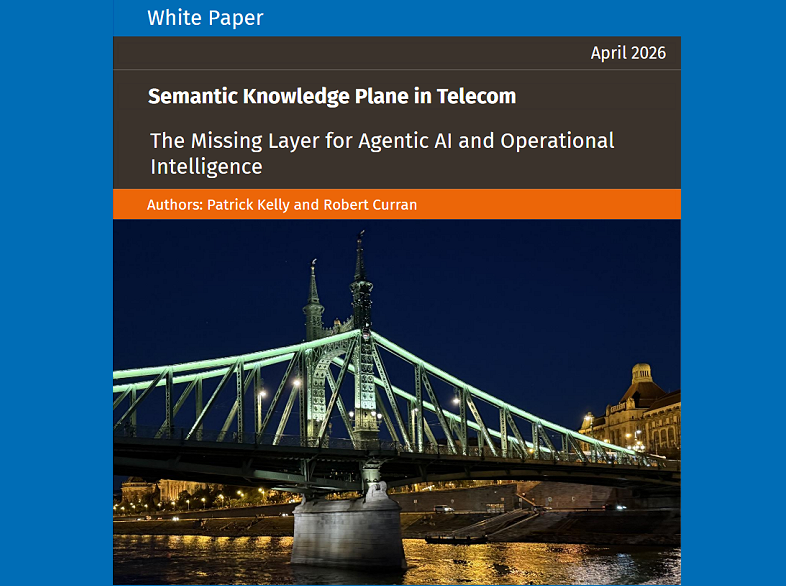
Appledore Research, April 2026. Authors: Patrick Kelly and Robert Curran. Sponsored by Vitria Technology. The analysis and conclusions are Appledore’s.
What is a Semantic Knowledge Plane?
Appledore defines it as a unified, semantically grounded, real-time model of network state, business intent and operational policy, expressed through a formal ontology, that lets autonomous agents observe, reason and act consistently across multi-domain environments. Where a data plane moves packets and a control plane manages forwarding, a knowledge plane is built for meaning — modeling not only what is happening but why, and what depends on what.
How it differs from observability and inventory
The paper is careful to position the knowledge layer alongside the tools operators already have rather than against them. Observability platforms capture what is occurring right now with high fidelity but do not address causality. Inventory and topology systems are authoritative for what exists and how it connects, but are static or slow-moving. A knowledge plane sits above both, ingesting from each and adding the causal reasoning that makes their output actionable.
Why agentic AI needs it
Appledore sets out three constraints on agents operating without a structured model of system relationships. They produce recommendations from pattern matching rather than causality. They are prone to hallucination and inconsistency because their outputs are not grounded in real system relationships — which in a telecom estate translates directly into outages and SLA breaches. And the absence of explainability undermines operator trust at exactly the point regulators are beginning to require that autonomous systems justify their actions in auditable terms.
Where to start
The paper’s practical argument is that a knowledge plane does not require wholesale transformation. It can be introduced into a brownfield estate against a bounded use case — cross-domain incident correlation, service impact analysis for high-value enterprise services, or root cause analysis in multi-vendor environments — integrating a limited number of sources and expanding as value is demonstrated. Appledore closes with five recommendations for operators, including investing in ontology design and governance early, and demanding concrete proof points from vendors before committing.
“Data alone does not solve operational problems. Understanding does.”
Business impact
Appledore quantifies the case: AI-augmented incident detection and response reducing mean time to recovery by 30 to 50 percent against manual processes, and mature implementations delivering 10 to 20 percent reductions in NOC operating cost. The paper also covers service quality, time to market, revenue assurance and the auditability that compliance teams increasingly ask for.
Who should read it
Operators moving from AI experimentation to operational deployment, and anyone building the business case for a knowledge layer rather than another data platform.
© Appledore Research LLC 2026. Sponsored by Vitria Technology. The analysis and conclusions are Appledore’s.