Resolve performance issues and detect problems before they affect end customers or impair system performance.
Becoming more efficient in addressing the time spent on troubleshooting and root cause analysis is more difficult with the emergence of more dynamic complex environments with more volume, variety, and data velocity.
IT Operational challenges:
- IT/network complexity is outpacing human capabilities
- Traditional siloed operations limits organizational intelligence
- Operational issues heighten managing and integrating large, complex data sets
- Legacy can’t keep up with the rapid growth in data volumes and the pace of change
- Operational costs are accelerating

Real Business Value Delivered to Vitria AIOps Customers


Reduction in incidents by 65%

Improved efficacy 20% annually

Service availability improved by 60 %

Reduced technician dispatches by 250,000
saving $16 million in Opex

Customer support contacts reduced by 18%
Frequently Asked Questions and Answers
What do you mean by context-aware decisions?
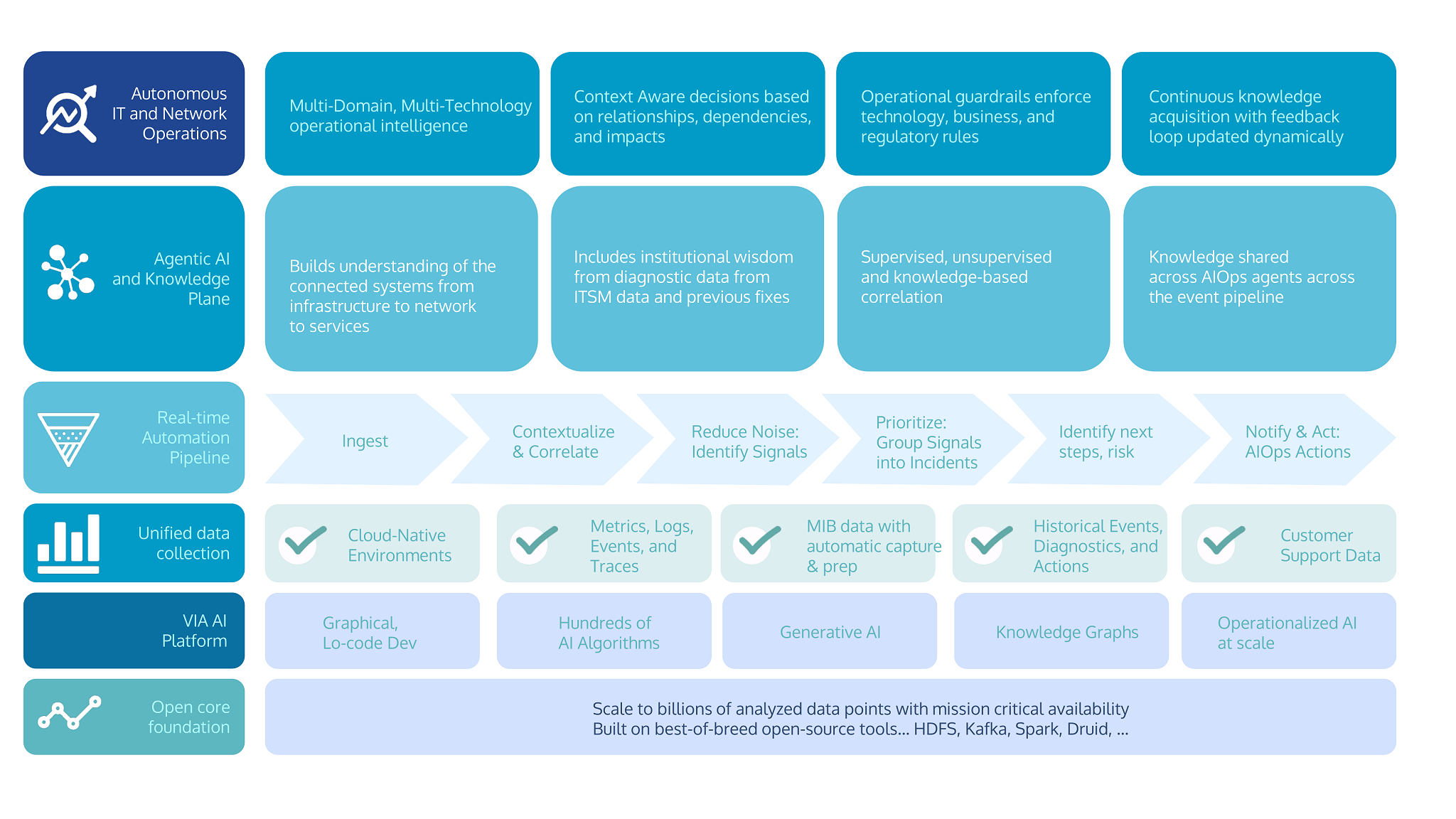
Monitoring tools and EIS solutions base decisions on a single point in time for the cause and effect of a problem. As a result, they are reactive and probabilistic. They lack a full understanding of the service topology, dependencies, and relationships between applications and the network they run on — or what prior action resolved the same problem.
VIA AIOps creates a system of understanding by learning from every incident and using embedded knowledge to automate action and close the loop into production. Through continuously evolving knowledge, VIA AIOps delivers a context-aware understanding of topologies, “blast radius” risk, and revenue implications.
What guardrails ensure VIA AIOps never takes unwanted action?
VIA AIOps uses deterministic reasoning to move from what happened to why it happened, eliminating AI hallucinations. It also automatically maps every autonomous action to SLA compliance, regulatory requirements, and revenue protection to ensure business-aligned healing.
How is data ingested into VIA AIOps?
Data is ingested via native connectors from applications, networks, and monitoring tools. Raw data can be onboarded in standard and nonstandard formats — with no need to fit a specific data model or specification, eliminating thousands of lines of code to ingest and parse data sets.
VIA AIOps simplifies ingestion through a GUI-driven toolset that analyzes sample data, auto-generates a real-time parser, and models the data for analysis.
How does VIA AIOps integrate with existing tools?
VIA AIOps is built on open standards and integrates easily with existing tools and systems. It ingests metrics, events, logs, and traces across all service layers from any source, and can be deployed alongside existing OSS, BSS, and network systems.
VIA AIOps delivers bidirectional communication with up- and down-stream systems such as IVR, service management, and trouble-ticketing systems — providing the capabilities needed to fully reach your automation objectives.
Learn more about VIA AIOps integration capabilities here.
How scalable is VIA AIOps?
Built for horizontal scaling, VIA AIOps reliably supports mission-critical operations with massive data demands. It is proven in environments with 50+ million devices, internet-scale networks, and billions of events per day.
VIA AIOps Features
Learn more about VIA AIOps key features by clicking the feature icons.

- Scales to billions of analyzed data points
- Supports mission critical applications reliably
- Enables integration with existing service management and monitoring systems
- Built on best of breed open-source tools – HDFS, Kafka, Spark, Druid…

- Enables explainable, trusted automation AI + Knowledge™ embedded inside workflows
- Uses knowledge graphs, telemetry, and multi-agent AI to create a system of understanding
- Operationalized AI at scale
- Accepts metrics, logs, event and trace data
- Ingests data via native connectors from applications, network and monitoring tools
- Onboards raw data in standard and non-standard formats
- Collects and runs data in cloud-native environments from a wide range of sources
- Ingests never before seen data in less than one hour with VIA’s Streaming Onboarding
- Does not require data to fit a specific data model or data specifications
- Eliminates the development of thousands of lines of code to ingest and parse data sets
- Automates the preparation and capture of MIB data for use in fault and performance management
- Supports historical event, diagnostics, and action data, as well as customer support data

- Ingest and aggregate metrics/events
- Contextualize and correlate
- Reduce noise and detect signals
- Group signals into incidents and prioritize
- Evaluation of severity, impact and causation
- Notify and take AI action
- Automatically learns the service topology, system dependencies, and the relationships between the network and services running on it
- Incorporates the institutional wisdom extracted from ITSM data and remediation workflows for next steps and automation
- Includes operational guardrails provided through semantic dictionaries enforcing technology, business, and regulatory rules on AI behavior

- Enablement of the journey to automated resolution and self-healing
- Incident Management process automation across infrastructure, application, and services
- Multi-step autonomous execution from diagnose, decide, remediate, and validate
- Explainability traced back to relationship, learned patterns, and known resolution
VIA AIOps End-to-End Service Assurance
Resources