
The Cable Business is Complex and Change is a Constant
- Size: $100+ billion dollar business, employing 214,000 people
- Complexity: Broadcast programming packaged with other services like internet access and telephony
- Pressure: Highly competitive, operators rely on premium service packages and exceptional service to sustain their competitive position.
The Cable Operators Challenge: Managing Change
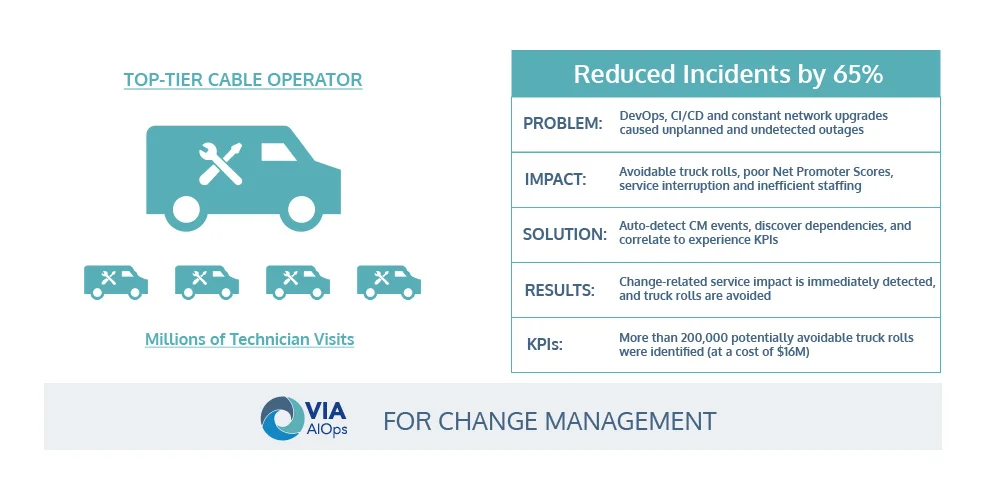
Frequent, minor network upgrades aren’t always communicated to everyone who needs to know DevOps and CI/CD are able to upgrade service packages quickly but can also introduce unexpected changes. Service interruptions resulting from change can be costly – in dollars and customer satisfaction. Avoiding costly trips to businesses and homes to restore service interrupted by these changes is a priority. What’s the solution?
- Automate response with early detection of problems resulting from change.
- Discover dependencies with TOTAL ECOSYSTEM OBSERVABILITY.
- Employ EXPLAINABLE AI to correlate third-party events, incident and change tickets.
VIA AIOps PREVENTS SERVICE INTERRUPTIONS RESULTING FROM CHANGE.


An Over-the-Top Video Service Provider Used VIA AIOps to Improve Their Customers’ Experience
Frequently Asked Questions and Answers
What is AIOps for cable operators?
AIOps for cable operators is the use of AI and automation to detect, diagnose and resolve service issues across the cable delivery ecosystem — access network, transport, data center and application layers. It matters more in cable than in most industries because change is continuous: upgrades, plant work and new service launches are ongoing, and each one is a potential source of subscriber-affecting incidents.
Why is change the biggest operational challenge for cable operators?
The cable business is a $100+ billion industry employing around 214,000 people, and its infrastructure is in constant evolution. Every upgrade or configuration change introduces the risk of degradation that traditional fault monitoring only detects once subscribers are already affected. Correlating change records against performance and fault data lets an operator connect a degradation to the change that caused it, rather than troubleshooting it as a novel fault.
How does VIA AIOps reduce technician visits and truck rolls?
By identifying the root cause of a service issue before dispatch, rather than after. When performance degradation is correlated to a specific change, network element or upstream dependency, it can often be resolved remotely or the correct fix dispatched first time. The recurring pattern in cable operations is that upgrades drive a rise in technician visits; the objective is keeping pace with system upgrades and service improvements without that increase.
Can VIA AIOps assure OTT and streaming video delivered over a cable network?
Yes. An over-the-top video service provider used VIA AIOps to improve customer experience by correlating data across the delivery chain rather than monitoring each layer separately. Video quality issues are typically a chain problem — the fault sits in a different layer from where the symptom appears — which is where cross-domain correlation matters most.
How does VIA AIOps fit with our existing OSS and ITSM tools?
VIA AIOps ingests data from existing monitoring tools as well as Melt data directly from devices. Integrating with existing ITSM platforms, incidents flow into the same workflow the operations team already uses, and resolution status flows back forming a closed-loop process. It is designed to sit across the existing tool set rather than replace it.
Resources