
Scale and complexity increase with each progressive level in the self-healing journey with AIOps
Levels of automation on the
road to self-healing

Level 0
Manual Operations
Traditional, manually operated networks & systems
Human operators trouble-shoot individual components
Vendor provided monitoring tools and dashboards
Level 3
AlOps and Partial Automation
Al-based correlation and grouping or related incidents
Probable cause and impact analysis
Automated ticketing of incidents in ITSMs systems
Level 1
Basic Monitoring
Consolidation of monitoring tools
KPis and standardized dashboards
Automated alerts with human trouble-shooting
Level 4
AlOps with High Automation
Advanced AlOps functionality
“Likely fix” predication
Automated remediation for many incidents
Level 2
Observability
Ingestion of metrics, events, logs, and traces (MELT)
Comprehensive views of system performance and health
Visual and temporal correlations of issues
Level 5
Full Autonomous Operations & Self-healing
Systems operate autonomously across most scenarios
AlOps-based self-healing capabilities
Minimal human intervention
Critical Milestones on the journey to Automated resolutions and self-healing

Full Observability
Comprehensive view of the entire service delivery system with the ability to monitor and detect signals across the ecosystem
Cross-Correlation
Correlate across service delivery domains and monitoring paradigms (FM, PM, logging,
APM…)
Recognize all related signals for a given service delivery issue and define a single incident
Root Cause Analysis & Likely Fix
Identify the actions that will remediate or mitigate the incident with the goal of reducing incident costs and minimizing repair time
Automated Fix & Intelligent Automation
Transformation goals of automated troubleshooting, automation of low risk fixes and routing of high risk fixes to the right fix team
Understand fix impact and evaluate alternative fixes
What’s required to Achieve Autonomous Networks?
Agentic AlOps
Multi-Agent Confidence-based Reasoning
Incident Resolution Copilot
Extensible Intent-Based Automation
Core AlOps
Full Ecosystem Observability
Multi-Model Al Correlation
Supervised, Unsupervised, Graph, Knowledge
Closed-Loop Remediation & Validation

Knowledge-Driven AlOps
Knowledge Augmented RCA & Next Best Action
Diagnose, Fix, Ticket
Embedded Knowledge Graph & Ontology Services
Autonomous Knowledge Acquisition & Management
Accelerate the Journey to Automation with Agentic AI and Knowledge
Agentic AI diagnoses and resolves. Knowledge is what makes those actions safe enough to trust.
Agentic AI
What the system does
Diagnose
- Correlation
- Root cause analysis
- Situational analysis
Resolve
- Likely fix
- Closed-loop remediation
- Automated ticket management
Work with operators
- ChatOps
- Knowledge workbench
Every action in the layer above is grounded in — and validated against — the knowledge layer beneath it.
Knowledge
What the system knows · structured as knowledge graphs
Topology
How the estate is actually wired, across every layer.
Learned dependencies
Relationships the system infers for itself from live telemetry.
Diagnostic knowledge
Which symptoms mean what, and which fixes have worked before.
Context
Where things physically are, and what that changes.
Knowledge-augmented AI delivers better results
Harvested Knowledge
- Knowledge harvested from service tickets, fix/repair data, chats, and other sources
Likely Fix Recommendations
- Recommendations generated by VIA GenAI using harvested knowledge
- Low-risk, low-impact recommendations can be automated
- High-risk or impact recommendations can be reviewed for acceptance or rejection
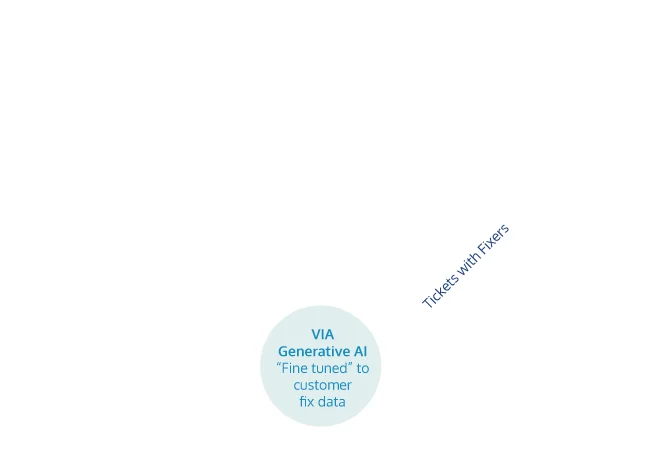
ITSM Tickets and other knowledge bases are harvested to “augment” the Vitria Generative AI knowledge.
Unleash inherent knowledge in troves of unstructured data that have been difficult/impossible to leverage in the past.
Knowledge Shared across all the Steps in the Pipeline
Improves Accuracy and Accelerates your Journey to Self-Healing with AIOps
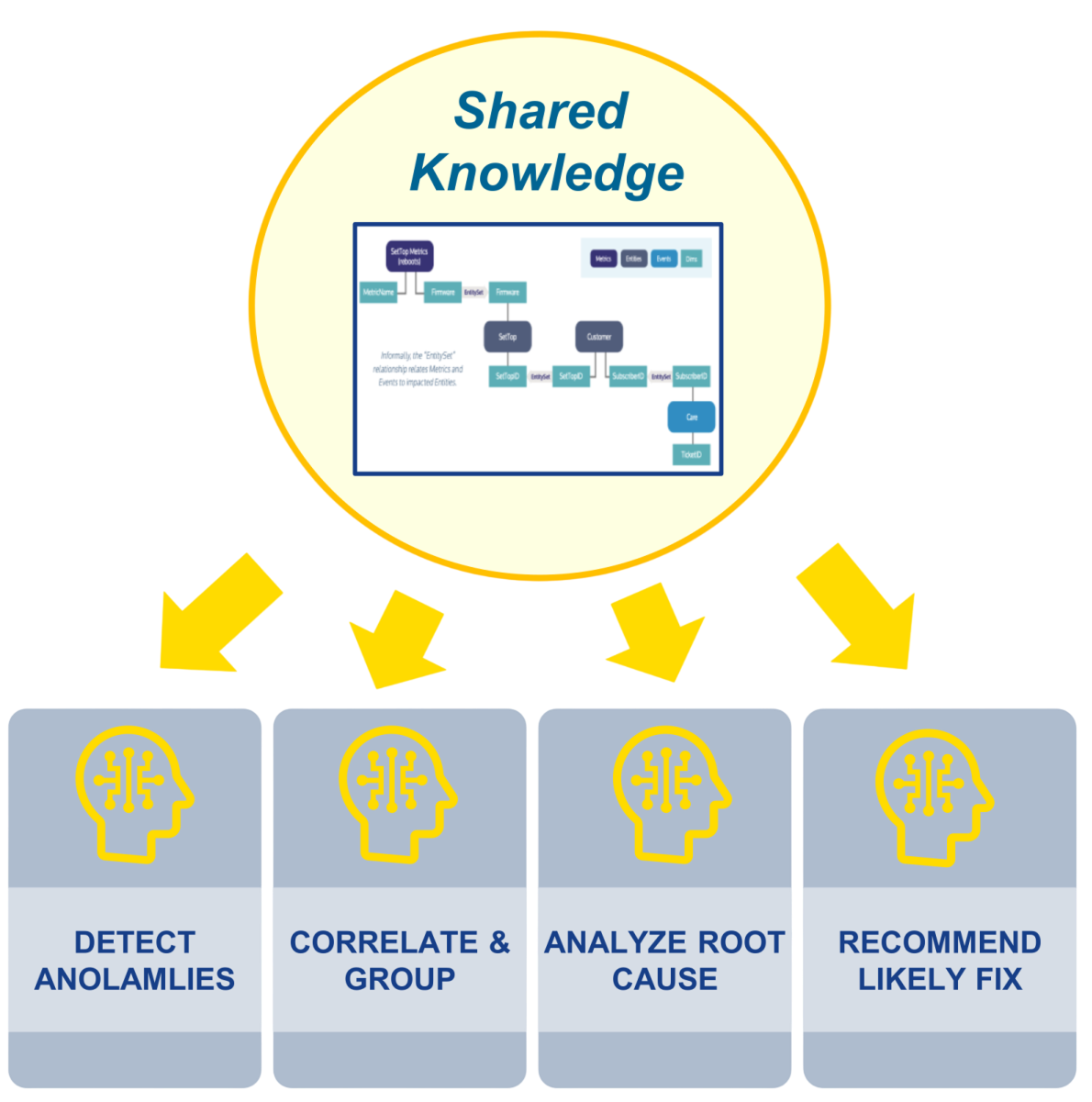
Shared Knowledge
Curated and shared across system layers.
Shared across Al agents in each step of the process.
Improving each Al’s reasoning.
Producing a multiplicative effect.
Shared knowledge improves the accuracy of Al algorithms and Generative Als.
Frequently Asked Questions
Autonomous Networks & Knowledge-Driven AI
What are autonomous networks?
Autonomous networks manage themselves with no human intervention. They adapt and respond to changing conditions on their own.
They work through continuous closed loops. When an agent completes an action, a closed loop evaluates how effective it was and stores that decision in memory to sharpen future decisions. A new loop then checks whether the issue is actually resolved—if not, it triggers a fresh cycle of root-cause identification and remediation. The network keeps healing itself until the problem is fixed.
Why does autonomous networking require AI?
AI provides the intelligence and adaptability a system needs to understand and respond to what’s happening in real time. But to be useful and trustworthy, AI must be grounded in a strong foundation of knowledge.
What is knowledge-driven AI?
Knowledge is structured, machine-readable information, often visualized as a knowledge graph. A knowledge graph maps not only the elements of a system but the interconnections and dependencies between them: the dependencies between layers in the network’s topology (both learned and inferred), failure patterns between components, diagnostic knowledge about key symptoms and likely fixes, and contextual knowledge about physical facilities, geographic locations, and environmental and weather conditions.
When this structured knowledge is added to AI, agents get smarter and produce more accurate results with fewer hallucinations. Their recommendations also become explainable through the knowledge graph—and verifiable by another AI or a human.
How is Vitria’s VIA AIOps platform solving the scale challenges operators face with Agentic AI?
As network and IT environments grow more distributed—spanning legacy infrastructure, 5G, cloud-native platforms, transport networks, and virtualized services—accuracy and trust become major barriers to Agentic AI. Vitria addresses this with a Semantic Knowledge Plane that infuses AI agents with better knowledge, delivering better accuracy and better results.
What operational impact are operators seeing from knowledge-driven AI?
Our customers have achieved:
* 95% proactive detection and triage before customer impact
* 20–30% year-over-year improvement in Network Operations Center (NOC) productivity
* Faster root-cause identification and remediation
* Reduced MTTR for complex service degradations
AI Works Smarter with Knowledge
Enhanced Reasoning
Enables AI to link concepts logically
Improved Accuracy
Answers become more precise with knowledge
Persistent Learning
Knowledge remains through updates or changes
Human & AI Synergies
Humans and AIs build on each others’ knowledge
Explainable
AI can justify answers using a knowledge graph
Verifiable
Answers can by checked by humans or via a knowledge graph
Guardrails
AI responses limited to knowledge-backed information
Knowledge is crucial to building Trust and Confidence in AI