GenAI High Impact Use Cases
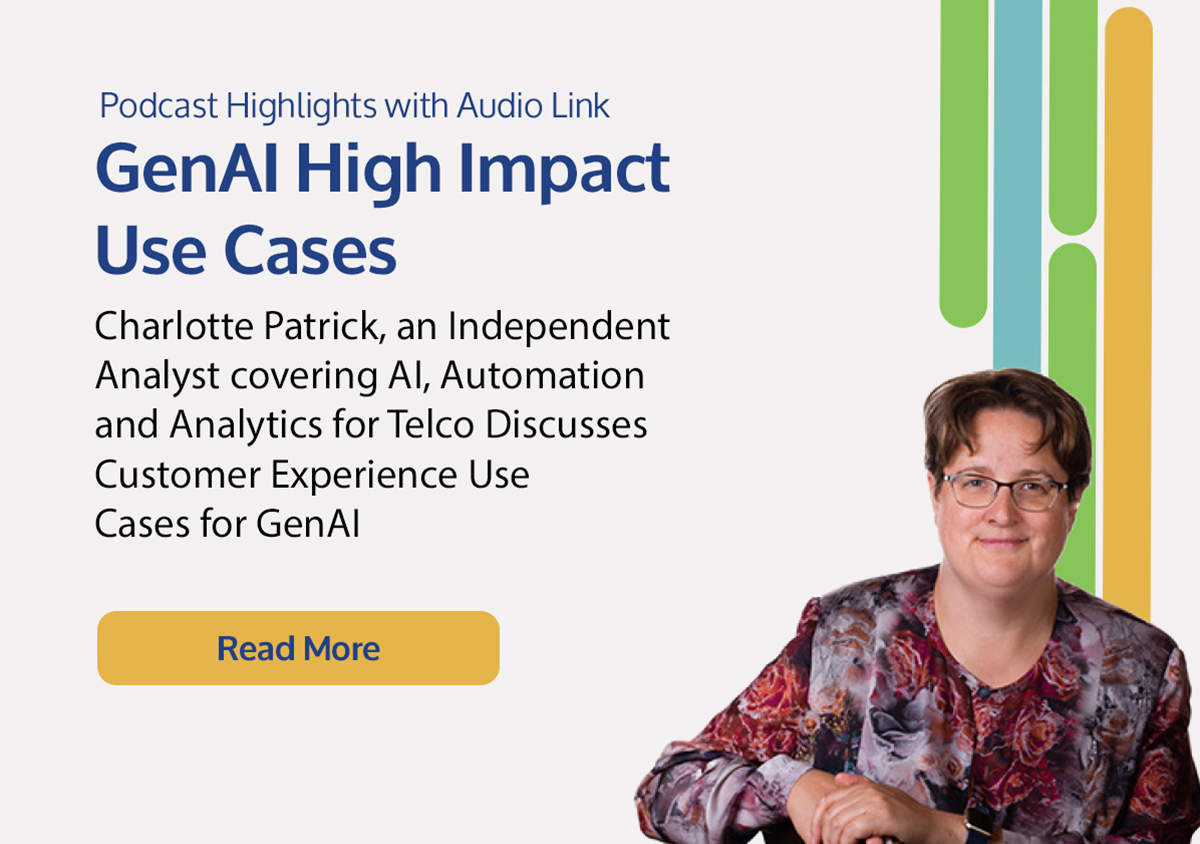
Charlotte Patrick, an Independent Analyst covering AI, Automation and Analytics for Telco Discusses Customer Experience Use Cases for GenAI
GenAI doesn’t solve all problems, but there are some interesting new solutions to age old customer experience issues particularly where there is a lot of complex information processed such as in the contact center and networks.
GenAI High Impact Use Cases – Summary
Explore practical GenAI use cases for telecommunications and customer experience. This podcast highlights how GenAI can improve contact center interactions, optimize knowledge, enhance operational collaboration, reduce service resolution times, and analyze complex network data—helping telecom teams deliver faster, more efficient, and intelligent operations.
GenAI High Impact Use Cases – Q&A
Discover how Generative AI can improve customer experience and operational efficiency in telecommunications. This report explores practical GenAI use cases for contact centers, incident response, knowledge management, and network operations, showing how AI can help teams resolve issues faster, reduce costs, and deliver better customer experiences.
GenAI High Impact Use Cases – Video
FAQ
Which generative AI use cases deliver real value in telecom operations?
The ones that compress expert time: summarizing incident context, recommending a likely fix from prior resolutions, and giving engineers a conversational route into operational data. Independent analyst Charlotte Patrick assesses which applications justify the investment and which remain experiments.
What are the main risks of generative AI in network operations?
Acting on inference without grounding. A model that generates a plausible remediation from incomplete context can propagate an error as fast as it would have resolved one. Grounding recommendations in a validated model of the network, and keeping a human in the loop, is what makes the speed safe.
How is GenAI different from the AI already used in AIOps?
Established AIOps uses machine learning to detect patterns and correlate events. Generative AI adds a language layer on top: explaining what was found, drafting the resolution, and answering questions in natural language. It is an interface and reasoning layer, not a replacement for correlation.