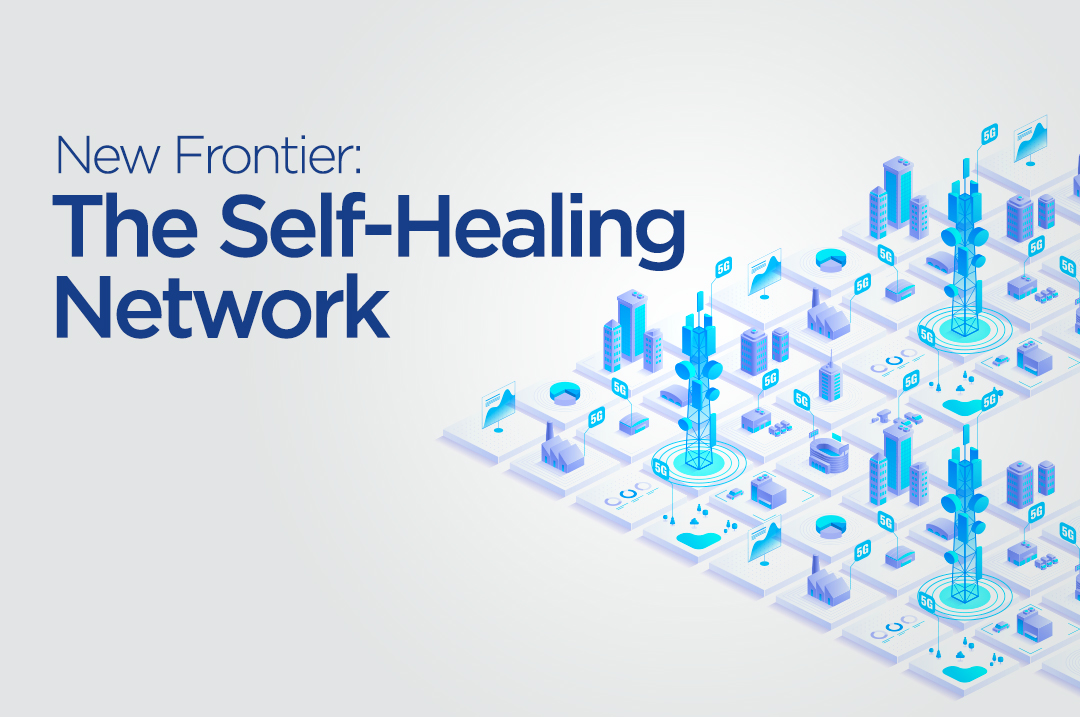
Autonomous resolution is the detection, diagnosis and repair of service-impacting problems without human intervention. A self-healing network is the end state: infrastructure that restores its own service. Both depend on a system that understands how services are assembled and how their parts relate — not simply which alarms fired and when.
What separates automation from autonomy?
Automation executes a fix somebody already wrote down. Autonomy decides which fix applies to a situation nobody anticipated. The gap between them is knowledge: an autonomous system needs a model of service topology, dependencies and past resolutions rich enough to reason over. Scripted runbooks cover known failures. Autonomy is what handles the rest.
Why do most automation programmes stall before reaching autonomy?
They automate actions without building the understanding that decides between actions. Teams reach a ceiling where every remaining incident is novel, ambiguous, or spans several domains — precisely the incidents a runbook cannot cover. Progress resumes only when the system can determine root cause on its own rather than matching a symptom to a stored procedure.
What is a knowledge plane, and why does autonomous resolution need one?
A knowledge plane is a semantic layer holding service topology, system dependencies and the relationships between every layer of an environment. Vitria’s VIA AIOps builds one as a knowledge graph assembled from real-time telemetry, CMDBs and network inventory, then augmented with historical incidents, resolutions and automated actions. Unlike a static configuration database, it updates itself as the environment changes.
How do you trust an autonomous action?
By making its reasoning inspectable before it runs. VIA AIOps applies deterministic reasoning with semantic guardrails, so a recommended action traces back to the structured knowledge that produced it rather than to an opaque model output. Every autonomous action is also mapped to SLA compliance, regulatory obligation and revenue impact, so the business consequence is visible in advance.
What does the journey actually look like?
It runs in stages: automated troubleshooting first, then automatic execution of low-risk fixes, then intelligent routing of high-risk fixes to the right team. Vitria structures this as 90-to-120-day projects, each extending coverage and increasing the share of incidents resolved without a human. Measurable return is expected within the first project rather than at the end of a multi-year programme.
Who this is for
Network operations directors, automation leads, and service assurance managers responsible for reducing manual incident handling at scale.
Cross-links
Network & 5G Assurance · AIOps Fundamentals · Telecommunications · Demos